
My bedroom was where I wrote as a child—writing poetry at age nine—and continued to write during high school. I wrote early in the morning before my mother awakened. She thought my writing was wasted time and would find tasks for me to do if she saw me writing or reading. Reading and writing under covers in bed was a talent I developed early.
I was writing before there were computers, so I wrote in longhand. I moved frequently in college so I only owned what I could carry and pack easily; I wrote at small side tables in tiny one room apartments, or at the library.
Moving into adult hood with houses and furniture, I did not have a real desk until I inherited my father’s desk long after he had died. A deacon in my father’s church hand built that desk. It is big, sleek, polished oak wood; and I see my father sitting behind that desk writing his sermons and his books, glancing up when I entered the basement room and reaching for his cup of coffee. I do not write at this desk. I had a computer there once upon a time, but now with laptops, I can go anywhere. The desk has become a holding spot for papers, supplies, backup electronics, and memories. I write at the dining room table, or any table that has a view. I need to be able to look out at the trees, see the flowers, follow a butterfly, and gaze at the antics of the squirrels. All part of the writing process as Nathaniel Hawthorne points out in “The Artist of the Beautiful.”
To have a place to write is part of the writing process and takes consideration. My writing place was not chosen haphazardly. I thought long and hard when I was beginning to write as to where I could write. I tried many different scenarios. Ultimately, I discovered that I could write just about anywhere I have a surface, a window, and time. Spancil Hill was written in Labane Village in Ireland. The house was next to a cow pasture. I would look out the window and the cows would be at the fence looking back at me. The Darkest Midnight in December was written at my dining room table looking out at the back yard. I witnessed a red shouldered hawk sweep down and capture a chipmunk. Tybee Rhapsody was started on Tybee Island, Georgia, during a trip that began with a gale warning while I was the only person staying in the Bed & Breakfast three-story house. The book was finished in my stuffed, flower-patterned chair in my living room and at the dining room table. I try to be versatile.
I have written in cabins and hotel rooms, in friend’s guest rooms, on park benches, at airports, train stations, and bus terminals. I have pulled my car over into a safe parking space and jotted down ideas and questions I needed to research. I always carry a hard cover journal, one of those 99 cent ones that have the marbled black covers with a place to write your name and pages that are stitched together so they don’t fall apart. I have dozens of them stacked in my study. I can’t throw them away; I might need something I wrote in one of them.
Knowing where a well-known writer has written leads reading fans to search for these places. I visited 48 Doughty Street in London to be awed by where Charles Dickens wrote. I have read all his books. Edith Wharton wrote in bed, longhand, in the mornings. Hemingway wrote in a library type room at Finca Vigia, his house in Cuba. Agatha Christie wrote in Pera Palace Hotel room 411 in Istanbul, Turkey. Mark Twain wrote in an octagonal hut at his in-law’s estate in Elmira, New York. Roald Dahl had a writing hut (inspired by Dylan Thomas’s). Victor Hugo wrote in a house he bought on Guernsey Island in the English Channel. Ray Bradbury wrote in a typewriter rental room in the basement of UCLA’s Powell Library. He rented a typewriter for 10 cents a half-hour. James Baldwin wrote in an upstairs room at Café de Flore in Paris. William Faulkner wrote at night while tending to a coal power plant in Oxford, Mississippi. Louisa May Alcott wrote in the family home in her bedroom in Massachusetts. Langston Hughes wrote in a brownstone two-room apartment in Harlem, New York. Maya Angelou wrote in rented hotel rooms, she sought quiet.
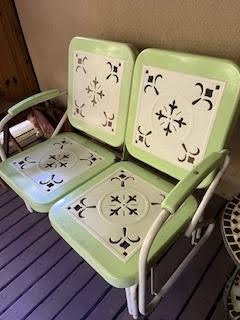
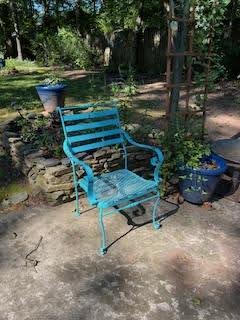
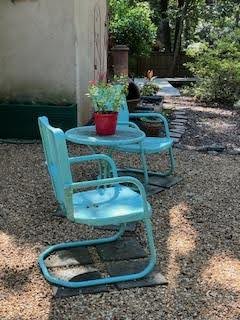
Each of these writers sought a perfect writing place that I call a “sit-spot.” I read that Native Americans had special sit-spots that were outside and gave them a place to connect with nature. I have those sit-spots. My seat at the dining room table looks out a sliding glass door. I sit on the mint green vintage glider out on my porch where I can hear the rain on the roof. I have several sit-spots in my garden with chairs under the tall oak and hickory trees. These sit-spots are places where I work out a plot problem, decide on a description, think through character dialogues, and breathe deeply. The connection with nature is part of how I choose my writing place.
As I prepare to go to Ireland, I have packed my hard cover journal and have another in my carry on. I will be looking for my sit-spot in Wexford.
 Leara Rhodes