
As a girl of eight, I studied a flying squirrel. In my back yard I attempted to leap from a wooden table and try my wings. I wanted to fly, to soar through the sky and over the trees. I wanted Tinkerbell to sprinkle fairy dust and include me in the nightly flights to Neverland. In my dreams I flew. I glided. I soared.
But, in the light of day, I realized that I cannot fly.
During these lifetime years, I have learned a lot about what it means to soar, to fly.
“Flying is like chasing the stars and believing they’re within reach.”
“The hardest part of flying is taking that first leap.”
“Fly as high as your dreams will take you and let nothing ground you.”
All these quotes motivate me. In my lifetime, I wanted to write. I wrote poems as a 9-year-old. I wrote yearbook copy as a teenager. I wrote news stories for newspapers and magazines as a college student. I wrote copy for corporate clients as a young woman. I edited a newspaper as an adult. But I wanted to write a novel. I started one, took it to the two weeklong Bread Loaf Writing Conference in Middlebury, Vermont. Returning home, I discovered I was three months pregnant. I never finished the novel. Years were spent working on a career in academic journalism. Finally, I was ready to retire. My daughter warned me that as active as I had been in my life, I needed a plan when I retired. I had a plan. I was going to write a novel.
I did. I wrote Spancil Hill. I spent two years looking for an agent. I rewrote the book several times. I then had an idea to write a second book. That’s when I found Old Fort Press and the experience of finding a publisher has changed my life forever. Old Fort Press published my first novel, then published my second novel, The Darkest Midnight in December. I have a plan.
Eight years ago, the notion of how I might fly surged again during my exit exam with the Emory Hospital knee surgeon. I told him that I knew I could not run, and I was okay with that because I did not enjoy running. However, I said, “I would like to learn how to fly on a trapeze.” He pauses, looks at me. “You mean you want to fly up in the air across space?” “Yes,” I said, eagerly expecting a positive response. Instead, he looks at me in silence, then says, “I think I would wait a few years.”
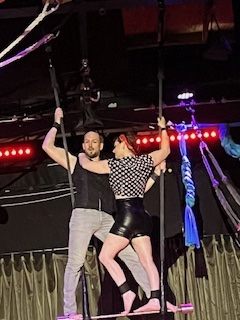
I have waited a few years. Long years and know now that my legs would not take what is needed to soar on the trapeze. So, I go to the aerial dance shows produced at Canopy in Athens and watch people I know in town, soar on the silks, climb the ropes, and swing across space. The music pours from the speakers and in costumes designed for their arial dance, they perform amazing feats in the air: twisting, and falling with the ropes and silks catching them as I catch my breath watching. Many of the performers are people I know in town. They are former students, friends, people with routine day jobs, who come to the ropes and find their strength in how they react in the air, alone and with others.
My pharmacist, Dr. Rabun Neves and her husband, James, a financial advisor, performed a couple dance on the trapeze. Sexy, loving, daring, twisting, and hanging on to arms, feet, legs, and torso, the couple produced a powerful moment in the air. They soared 20 feet above ground, and I watched in awe. Then it came to me. To fly, really fly, they tell stories up in the rafters. They feel the music and add their own interpretations. They create up in the air.
I do the same. I create stories. I put characters in historic dress with culture, food, and music. I study Irish immigration and write about it. My latest book, Tybee Rhapsody, is in the publisher’s hand with hopeful release in the Fall. In this book I quote Henry David Thoreau: “If you have built castles in the air, your work need not be lost; that is where they should be. Now put the foundations under them.”
The novel’s main character, Gertrude, wants to be a classical pianist and to compose music as an Irish woman in 1907 in Savannah and then on Tybee Island. To do so, she must learn how to take those music castles she has created in the air and put foundations under them. The lessons she learns allows her to fly. In my writing of historical novels about Irish immigrants, I have found my own way to fly.
 Leara Rhodes