
My father loved Thomas Wolfe and would read his books over and over. I grew up hearing quotes from “You Can’t Go Home Again”:
You can’t go back home to your family, back home to your childhood, back home to romantic love, back home to a young man’s dreams of glory and of fame, back home to exile, to escape to Europe and some foreign land, back home to lyricism, to singing just for singing’s sake, back home to aestheticism, to one’s youthful idea of ‘the artist’ and the all-sufficiency of ‘art’ and ‘beauty’ and ‘love,’ back home to the ivory tower, back home to places in the country, to the cottage in Bermuda, away from all the strife and conflict of the world, back home to the father you have lost and have been looking for, back home to someone who can help you, save you, ease the burden for you, back home to the old forms and systems of things which once seemed everlasting but which are changing all the time–back home to the escapes of Time and Memory.
I need to read this particular book again after attending my high school reunion after so many years away.
Griffin is not the easiest place to visit. A town that is not between here and there, nor has it anything a tourist would like to see. A town that is three blocks by two blocks wide and has a history linked to twelve textile mills and five mill villages. In high school, we were separated by white socks and madras shirts: the mill and the professional families. I grew up hearing the Highland-Crompton mill whistle at six every weekday morning. We did not fall into either group; therefore, we were outsiders.
My first job when I was 15 was at the JoAnn Shop on Hill Street as a sales clerk. Today that shop has been gutted and stuffed with “collectibles.” The shop I knew no longer exists. Downtown had been filled with shops: Claxton’s Pharmacy, Rose’s Department store, a buffet in the corner hotel on Solomon Street. None of these exist and most are empty storefronts, replaced by cigar and vape stores. The movie theater on Solomon was a date-night destination. We would enter the movie no matter when it had started because my boyfriend had to drive in from college and I had a curfew. When we got to the part of the movie where we had entered, we got up and left. I did not see a movie from the beginning to the end until I was in college. Now the entry way is a gate into a small park with benches. The theatre does not exist.
Walking around downtown, I see small plaques on the buildings. All are identical: name of military person who had died, rank, and years. No other information offers an insight into who these people had been. They were real people but their identity has been reduced to these few facts. The downtown has become a graveyard. The vibrant town I remember does not exist. I sit at a table on the sidewalk downtown and order an appetizer. The church bells begin to chime, then there are 15 minutes of the carillons ringing out old Christian hymns I have memorized. I ask the wait staff if the carillons play after each hour or just at six. They have no idea what I am talking about and did not even know the difference between the chimes and the carillon.
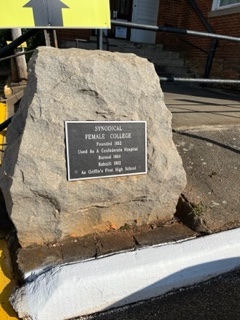
One block from downtown is the old, once-upon a time, high school campus, full of two-story red brick historic buildings. Aluminum awning walkways connect buildings but many end at brick walls rather than doors. There are so many that it is impossible to get a clear photo of the old buildings and the tree-lined campus. The stadium across the street is much smaller than my graduation photos depict. The auditorium where I often sang in the Friday morning chapel programs is obstructed by a bigger and more affluent city auditorium squeezed in between the old original library on the corner and the end of the high school building with the auditorium. Two years after graduating, Griffin High School merged with Fairmont High in 1970 and the Eagles became the Bears. The high school I knew no longer exists.
Time is passing. Next to visit is the house in Hillandale where we moved when I began high school. A big, lovely Wedgewood blue painted brick house with a long straight sidewalk to the street had been replaced by a similar style (all the windows and doors were in the identical place but the house seemed much smaller) brown painted brick house with a shorter distance to the street and four cars and trucks in the driveway. It may have been the house we had lived in; it certainly has changed.
Finding the Kiwanis Building at the fair grounds for the high school reunion is easy, I had sung at the fair grounds during high school. I remember that I wore a strapless red velvet dress and sang the song from Moulin Rouge, “Where is Your Heart.”
Whenever we kiss
I worry and wonder
Your lips may be near
But where is your heart
It’s always like this
I worry and wonder
You’re close to me here
But where is your heart
It’s a sad thing to realize
That you’ve a heart
That never melts
When we kiss
Do you close your eyes
Pretending that I’m someone else
I must break the spell
This cloud that I’m under
So please won’t you tell
Darling where is your heart
I remember the lyrics and began singing it in the car—that should have been my final clue to turn around and drive away. Wolfe was correct that one can’t go back home again, “back home to the old forms and systems of things which once seemed everlasting but which are changing all the time–back home to the escapes of Time and Memory.”
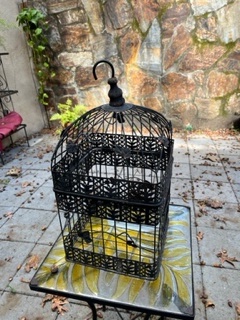
The high school reunion is history. I drove out of Griffin early the next morning, though, with the following: a memory of singing at Judy Robertson Griffin’s wedding, a story Em Claxton Barton shares with me about our trip to attend Girl’s State at UGA, and a bird cage I purchased from the old JoAnn Shop building. The top half of the cage is removeable; the hinges that were there to hold it together have rusted off, as is the clasp at the front of the cage. The wire cage with its ornate decorations is completely useless to hold anything but memories of a bird that has flown away.
 Leara Rhodes